
The Quiet Power of Humility
The science and scripture of humility

About This Week
Each week I’ll post an overview of what to expect in the upcoming week. This week we’ll be building our foundation to a closer walk with God on humility. As I said in the overview of this devotional, the key is to tie psychology and Scripture, and this overview will provide the research behind the reason for the devotional.
There’s a reason it is nearly impossible to imagine a truly great spiritual leader who lacks humility. Across every tradition and era, those who have touched hearts have shared a common quality: they were focused more on others than themselves. Humility isn’t a personality quirk or a cultural nicety, it’s a choice to develop one of the most demanding and transformative virtues a person can have. Politicians, celebrities, athletes, warriors… we can imagine those without humility quite easily, but when it comes to spiritual leaders, humility is a foundation of their core.
What Humility Actually Is
We often mistake humility for something soft, maybe gullible, passive, and tied to low self-esteem, or reflexive self-deprecation. True humility is none of these things. Genuine humility is the strength to quiet the ego and ignore the voice of self-promotion and self-protection in order to truly learn, observe, and connect with others on a different level. It involves a relative lack of self-preoccupation, a willingness to acknowledge mistakes, genuine openness to other people’s ideas, and a deep appreciation for the many different ways people contribute to the world around us.
At its root, the English word humility shares its origin with the Latin humus, which means ground or soil. To be humble is to be grounded, unpretentious, and down-to-earth. It means seeing things as they actually are, not with the selfish goals that pride and ego introduce. Biblically, humility is described as a heart attitude, not something we do or how we behave, it’s a lowliness of mind that goes deep into our soul.
What Research Tells Us
Though humility has received less scholarly attention than other character virtues, the research that exists provides some surprising results. For example, greater humility correlates with higher self-esteem, deeper gratitude, a greater capacity for forgiveness, stronger spiritual health, and even better physical health (Rowatt et al., 2006). Far from making a person weaker or more passive, humility appears to strengthen nearly every dimension of well-being.
Humble people also respond to failure differently, with a growth mindset, rather than a fixed mindset. Rather than deflecting blame or shutting down when confronted with criticism, humble individuals tend to take responsibility and increase their efforts to improve (Zell, 2008). In leadership contexts, this quality builds trust: when a leader admits they don’t have all the answers, it lets everyone around them that honesty is safe, and failure is a part of life. Contrary to what some might think, humility isn’t something that prevents growth and achievement, it’s the foundation of it.
Seven Practices for a Humble Heart
The following seven daily reflections will be the focus of our week-long journey into humility. Each one targets a specific place where pride is often in our blind spot: in our motives, our resistance to correction, our need to appear capable, and our grip on outcomes. Together we’ll begin a journey from self-examination all the way to surrender.
- Day 1 — Heart Examination Before God
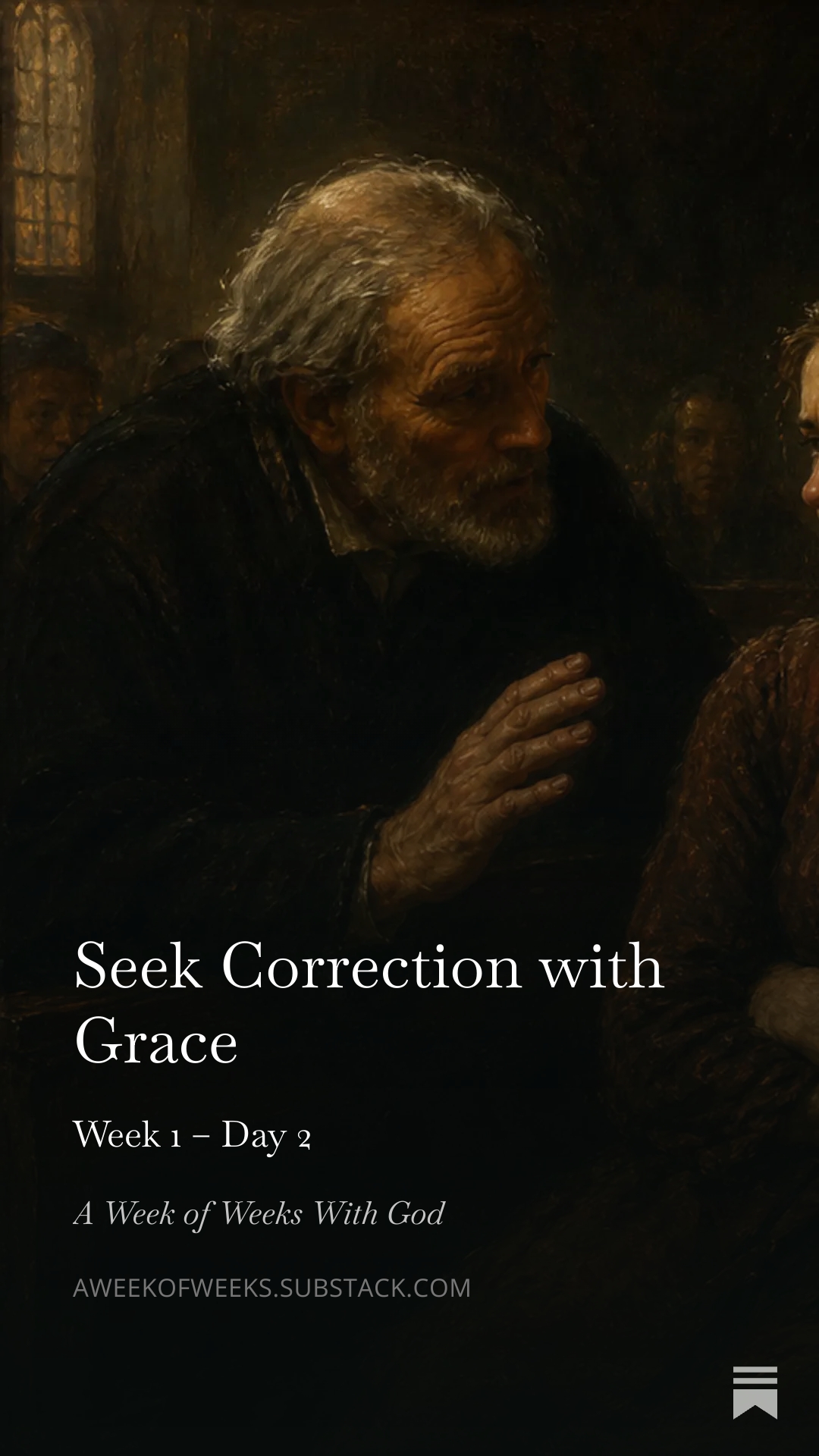
“Search me, God, and know my heart.” Psalm 139:23–24 - Day 2 — Seek Correction with Grace
“Faithful are the wounds of a friend.” (Proverbs 27:6) - Day 3 — Acknowledge Limitations Publicly
“Blessed are the poor in spirit, for theirs is the Kingdom of Heaven.” (Matthew 5:3) - Day 4 — Practice Intellectual Humility
“Trust in Yahweh with all your heart, and don’t lean on your own understanding.” (Proverbs 3:5) - Day 5 — Celebrate Others’ Achievements
“Rejoice with those who rejoice. Weep with those who weep.” (Romans 12:15) - Day 6 — Ask for Help Humbly
“Bear one another’s burdens, and so fulfill the law of Christ.” (Galatians 6:2) - Day 7 — Surrender Control to God
“He went away again a second time, and prayed, saying, ‘My Father, if this cup can’t pass away from me unless I drink it, your will be done.’” (Matthew 26:42)
A Life Shaped by Humility
Humility, the research suggests, is linked to a life of quiet joy, satisfaction, wisdom, and contentment, and what we might call a sacred quality of existence that is easy to miss but deeply felt when it is present. It enhances every relationship it touches, softens the pain of failure, and creates in a person the heart where God, and others, are genuinely welcomed in.
As we read the research, the unexpected thing we learn about humility is this: the less you grasp for significance, the more you seem to find it. The less you grip your outcomes, the more peaceful your inner world becomes. As C.S. Lewis once observed, the truly humble person is not one who thinks less of themselves, it is one who thinks of themselves less.
The Seven Days






Rowatt, W. C., Powers, C., Targhetta, V., Comer, J., Kennedy, S., & Labouff, J. (2006). Development and initial validation of an implicit measure of humility relative to arrogance. The Journal of Positive Psychology, 1(4), 198–211.
Zell, A. L. (2008). Pride and humility: Possible mediators of the motivating effect of praise. Dissertation Abstracts International: Section B: The Sciences and Engineering, 68(9-B), 63–96.
Stay on the Journey
Get each new week’s devotional delivered straight to your inbox.